Jumat, 06 Maret 2020

Ishar: Trophy RPG
 |
| A minotaur takes apart my party while I hit him occasionally for 2 hit points. |
Aside from its graphics and sound, which I began my first entry by praising, Ishar feels like a "lite" version of every game that inspired it. It's like it took a bunch of other RPGs but only copied their most superficial features. It has the character attributes, skills, and leveling of a lot of RPGs, but not with any depth or complexity. It has the switches and keys of a game like Dungeon Master but none of the challenging puzzles. It has a combat system that looks something like Might and Magic III or Eye of the Beholder, but it doesn't really get it right. It's like a movie with great cinematography but bad acting and not much of a plot.
I don't know how to judge its combat system. Either the developers screwed up or they deliberately did something different but in doing so introduced new problems. On the surface, it adopts a Dungeon Master convention of giving each character an attack button and having them trade attacks with enemies in real time. It even does one better by mapping the attacks to the function keys. The problem is that there's no cool-down, so it hardly makes sense to have all your characters attack. In fact, it makes the most sense to have the character with the best combat skills attack exclusively, keeping the others up front only as meat shields, to spread out the damage taken from enemies. The attacking character has to eat more often to regain stamina, but otherwise there's no downside.
I'm not sure I understand the little combat formation grid that you can activate on the right side of the screen. Each character has a unique symbol, and you can arrange those symbols on a 5 x 5 grid to make ranks and formations. It's not a bad idea, but I don't think the game really makes full use of it. Characters not in the front rank can neither hit nor get hit in melee combat, but beyond that, I don't see where the specific position and arrangement matter. Someone correct me if you know more.
 |
| This arrangement doesn't seem to do anything different than putting one character anywhere in the front rank and the other characters anywhere in the other four ranks. |
The worst part about combat is how the game treats missile weapons and spells. If a character is equipped by a missile weapon, hitting the attack key doesn't launch it; it brings up a cursor so that you can click on the specific enemy that you want to target. Why is this extra step necessary? Melee weapons don't target specific enemies. If combat paused while you made your selection, that would be one thing, but instead enemies continue to attack while you take your hand off the keyboard and move it to the mouse to point at a specific enemy and click.
Spells are even worse. To cast one, even in combat, you have to click the "Action" button, then "Cast Spell," then the name of the spell, and then target it, all while enemies are pounding away.
 |
| Casting takes too much time to do in combat. |
Both missile weapons and spells are a god-send, however, when you encounter the occasional enemy who refuses to advance. I wasted a lot of hours trying to melee a minotaur guarding a bridge with a morningstar in each hand. After several full-party deaths, I realized I could stand a square away and pelt him with arrows (albeit expensive ones), "Magic Missile" spells, and daggers until he finally collapsed.
A lot of spells are defensive or healing spells, and party members are useful for their other skills, including "Lockpicking," "First Aid," and "Languages." But you need far fewer than the four companions you can choose to go on the adventure.
As for the innovations with NPC interactions, they've mostly been annoying. The one time I tried to kick an NPC out of my party, the other characters voted to overrule me and keep him. Meanwhile, NPCs that I want to retain have a way of disappearing in the middle of the night, with all the expensive stuff I've bought for them, when we stay at inns.
 |
| Coward. |
I broke off the last entry by suggesting that I was going to try to map the island, which I estimated at 100 x 400 and concluded was "big but not unmappable." That's the problem with doing multiplication in your head. I had calculated it at 4,000 squares, which is the same size as a dungeon of 10 levels of 20 x 20. In fact, 100 x 400 is actually equal to 40,000--not Fate: Gates of Dawn, but still a few too many to map unless you really love the experience.
Upon studying the map in more detail, I realized that a map might be superfluous anyway. Kendoria is a large place--much longer east-west than north-south--but it's mostly made up of small islands interconnected by bridges. It doesn't take a lot of effort to comprehensively explore an island. You just run around its perimeter and crisscross the interior a few times.
 |
| Kendoria is less a "land" than an archipelago. |
The game begins on the furthest-west island, which is divided into Fragonir to the north and Angarahn to the south. Fragonir had the village on the docks, while Angarahn had the other village I explored last time. Between the two of them, they have a strength trainer and an agility trainer, but I still haven't felt flush enough to use them. Angarahn has some encounters with orcs that seem to respawn. Enemies typically leave bags of a few hundred gold when they die, but it costs about 1,500 gold pieces to have a meal and a night's sleep at a tavern.
East across the bridge from Angarahn is a large island with Lotharia on the west and Fimnuirh to the east. Lotharia has a small village to its north with a spell trainer. There were several encounters with werewolves or maybe bears, probably bears because later I fought somethings that looked more like werewolves. Fimnuirh is a huge, empty area where I keep getting attacked by something that I can't see. I suspect that this is the "invisible lizard man" named Brozl that I learned about in an NPC's hut. The NPC told me that to kill him, I would need to use a Mental Vision Helmet, wherever that comes from. I'll need to kill Brozl because he has some magic rings that "protect from the dragon's fire."
 |
| I have no idea what race this NPC is. |
There was an interesting encounter in Lotharia with a floating head calling himself "Azalghorm the Spirit," the messenger of the "Silmarilian Gods." He told me that we "could attempt" three quests, all of which would help us "when you finally have to face [the] evil Krogh." He said the quests were called "The Magician's Talisman," "The Exhausted Witch," and gaining possession of all of the rune tablets. I have no bead on the first two quests, but I found one rune tablet on a pedestal in Lotharia and the other on a pedestal in the dungeon.
 |
| The main quest turns into sub-quests. |
East from Fragonir and north from Lotharia is a small area called Osthirod. There were some encounters with tall, powerful werewolves plus a hut where a "medium" offered to give me medical advice for 1,000 gold pieces. I took a screenshot of some kind of tall sentinel in armor blocking access to some part of the area, but I neglected to mark where it was.
Most of my NPC companions were killed by the bears and werewolves, plus some bandits that I met in Osthirod's neighboring nation of Rhudgast. I replaced them with a weird monk named "Unknown," a warrior named Fragorn, and a priest named Kiriela, who I found standing around the wilderness of Fragonir. Soon afterwards, Fragorn disappeared when we stayed at a tavern for the night, so I replaced him with a terribly effective "spy" named Nasheer. Unknown is kind of useless except for his "Magic Missile" spell and Kiriela is useless except for her "Healing I" spell. Golnal is just useless, but the party wouldn't let me kick him out. Aramir remains the best melee fighter.
 |
| Who's your god? Hugh Hefner? |
Osthirod and Rhudgast occupy the same island, separated by a large, impenetrable thatch of forest. You have to cross between them on a small strip of land to the south. A pathway leads north from this strip of land to a dungeon entrance--the first in the game. There wasn't much of a transition as I entered the dungeon, and it was small enough that I suspect it exists on the same scale as the outdoor map and could be mapped on the same piece of paper with it.
 |
| The dungeon had some keys and levers but no puzzles. |
The dungeon was small and to-the-point. There were some doors I had to find keys to open and some barriers I had to lower with a lever. Monsters included skeletons, giant spiders, and some behemoth that took a couple of reloads.
 |
| The photographer didn't make it. |
The rewards for the dungeon were a few treasure chests, an empty flask, and a rune tablet.
 |
| Primitive cultures. They're always placing rune tablets on a pedestal. |
All geography ultimately funnels to the land of Aragarth, on the far eastern side of the Osthirod/Rhudgast island. A bridge leads from Aragarth to what is essentially the second half of the game, and this is where I got bottlenecked for a time by a minotaur, until I learned how to kill him from a distance. On the other side of this bridge, I found the land of Silmartil, a much less hospitable place than the western lands. After I died at the hands of some barbarians, I decided I'd better do another loop around the lands I'd already explored and grind a bit.
I mostly need to start spending some money. I've been very stingy. My characters would probably do better with some more armor (so far, I've only found leather), helms, and shields, and everyone could train a few points in strength or agility perhaps. I need to stockpile more rations to restore Aramir's stamina, since every attack reduces it by 1%. If the dungeon respawns, that might be an easy way to earn both experience and wealth.
 |
| This is probably the key to character development. |
Aramir is Level 6 now, everyone else either 3 or 4. I guess leveling affects maximum health and stamina, but as far as I can tell, skills are fixed from the beginning. (Unless they increase when you pay for attribute increases.) I'd probably do well to try to find better party members, but then again maybe I should be grateful that I have four of them who seem to get along and don't bail on me at night.
To recap, Ishar is a pleasant enough game, but one that doesn't grip me with its mechanics or its story. At least it's pretty to look at.
Time so far: 6 hours
Readmore »»
Existentialism And Essentialism

How many of then however strayed into typical "enlighten the deluded masses that need to be rescued from their perverse religion"?
(That is no bad thing in one sense as most religions are false. There is only one true religion the Catholic Faith and all the rest are evil in some way or another- Islam, Hinduism, Judaism, Buddhism, Calvinism, Pentecostalism, Anglicanism- they are false religions.)
But even worse, and even more toxic, how many of them essentially preach the doctrine of existentialism.
Man comes to realise that he does not have an essence- his essence is simply his existence- he makes who he is. Man is. There are no laws he must obey, no standards he is called to and no way of life that makes sense of the world.
This is problematic. Deeply problematic.
The challenge of the Christian RPG is to promote essentialism- you have a nature, you have a destiny, you have an end point, you are charged with a mission, you have inbuilt rules, you inhabit a world in which you have a place even if you don't know it yet, religion can help you discover who you are, your essence, your vocation, the meaning written into every fibre of your being.
This can be exciting too. In fact it can be far far more exciting that having a revelation that you are nobody and that your life is in fact empty of meaning.
We all find joy and experience a sense of expansion even in discovering some weird fact about a biological relative, say a grandfather. Imagine tomorrow you discovered your great great great grandfather was a prince who had been exiled from some small European state 150 years ago. Wow! And you are in fact the heir to that kingdom! Wow!
The joy of discovering your true place in the story of the world is awesome and the amazing thing is- God does have a place for you in this story.
Freedom means you can deviate and reject this role,
in eternity you will discover it, you will see your essence, who God had intended and designed you to be.
Unfortunately the vast majority of souls will gaze upon this essence in rage, amidst the fires of hell, for only those who conform themselves to this image, this vocation, this essence will make it to purgatory and through purgatory to heaven.
Domine ut videam.
Lord help me to see who I am, who you have made me, help me to live according to your design for me, to flourish and to lead others to this fulfillment that solely comes through relationship with you- in and through the one church you founded. Readmore »»
Kamis, 05 Maret 2020
A Word About The Polish Gaming Market
Last January, I was travelling in the European east. The main purpose of this trip was to finish my post-doctorate research about "Advergames: games as marketing tools" that I developed with Paneurópska vysoká škola at Bratislava (Slovakia). I presented the results and it was great (one more trophy achieved on the academic game).
After some days in Bratislava, I travelled to Kiev (Ukraine) and then to Krakow (Poland). In the last part of this trip, in Poland, I visited one awesome gaming studio named Moonlit. Knowing that the Polish land is a great market for games, I sent some e-mails trying to contact people from the local industry to share some ideas and discover new points of view. I talked to Mateusz Wanatowicz, PR and marketing specialist in Moonlit Games. Below, I surmised our conversation, sharing highlights of the polish gaming industry, Moonlit projects and an overview of polish gaming market.
1.Why do we need to pay attention to the Polish gaming market?
Well, it's one very important market in the central Europe. According to the last Newzoo gaming research, the country (with a population of 34 million people) has profited around 500 million dollars with gaming products. In comparison to Brazil - a country with 210 million people and a profit of 1.3 billion dollars in the gaming market - it's a very interesting emergent market to pay attention to.


2. About Moonlit Games studio
Moonlit is a gaming studio and a software house. In 2018, the company started to produce two authorial projects: Playerless - an arcade game where you need to fix bugs and the NPCs to run it correctly (PC); and Ignis - a battle arena game with wizards, sorcery and combats (PC and Xbox). Below, you can check some trailers and contents from both games.


3. Some aspects of the Polish gaming industry
It is a promising industry as we saw in the first topic. According to Wanatowicz, the government of Poland sees this industry as a profitable area to invest money in and an entry door for many startups and small initiatives for new business. Wanatowicz highlighted that big events, games jams and young talents are receiving support from the government; and, another important point: careers in gaming area (coding, game designing, 3D art etc.) are also prominent in the academic area.
Another important thing to mention is the fact that the games from the series "The Witcher" were a way to present the Polish gaming industry to the whole world.
It is important to say that board games and card games have a main role in this context too. Local production of analogic games is growing year by year.
4.Polish gamers
Wanatowicz also said that Polish gamers, in a general way, support the local industry and they are proud of the national industry and gaming production.
5.A final message to the Gaming Conceptz audience
Mateusz Wanatowicz emphasizes that part of the success of a gaming industry is about how government, gamer community, studios/companies and universities can join powers to create a fertile ecosystem for different kinds of projects. Big initiatives as "The Witcher" series are fundamental, but supporting indie studios, small startups, events and clear marketing rules are also a key for a good gaming market.

Note: check Moonlit works in the official site and social media by clicking in the links!
#GoGamers
Readmore »»
After some days in Bratislava, I travelled to Kiev (Ukraine) and then to Krakow (Poland). In the last part of this trip, in Poland, I visited one awesome gaming studio named Moonlit. Knowing that the Polish land is a great market for games, I sent some e-mails trying to contact people from the local industry to share some ideas and discover new points of view. I talked to Mateusz Wanatowicz, PR and marketing specialist in Moonlit Games. Below, I surmised our conversation, sharing highlights of the polish gaming industry, Moonlit projects and an overview of polish gaming market.
1.Why do we need to pay attention to the Polish gaming market?
Well, it's one very important market in the central Europe. According to the last Newzoo gaming research, the country (with a population of 34 million people) has profited around 500 million dollars with gaming products. In comparison to Brazil - a country with 210 million people and a profit of 1.3 billion dollars in the gaming market - it's a very interesting emergent market to pay attention to.
2. About Moonlit Games studio
Moonlit is a gaming studio and a software house. In 2018, the company started to produce two authorial projects: Playerless - an arcade game where you need to fix bugs and the NPCs to run it correctly (PC); and Ignis - a battle arena game with wizards, sorcery and combats (PC and Xbox). Below, you can check some trailers and contents from both games.
3. Some aspects of the Polish gaming industry
It is a promising industry as we saw in the first topic. According to Wanatowicz, the government of Poland sees this industry as a profitable area to invest money in and an entry door for many startups and small initiatives for new business. Wanatowicz highlighted that big events, games jams and young talents are receiving support from the government; and, another important point: careers in gaming area (coding, game designing, 3D art etc.) are also prominent in the academic area.
Another important thing to mention is the fact that the games from the series "The Witcher" were a way to present the Polish gaming industry to the whole world.
It is important to say that board games and card games have a main role in this context too. Local production of analogic games is growing year by year.
4.Polish gamers
Wanatowicz also said that Polish gamers, in a general way, support the local industry and they are proud of the national industry and gaming production.
5.A final message to the Gaming Conceptz audience
Mateusz Wanatowicz emphasizes that part of the success of a gaming industry is about how government, gamer community, studios/companies and universities can join powers to create a fertile ecosystem for different kinds of projects. Big initiatives as "The Witcher" series are fundamental, but supporting indie studios, small startups, events and clear marketing rules are also a key for a good gaming market.
Note: check Moonlit works in the official site and social media by clicking in the links!
#GoGamers
My Presentation For DIGRA 2018 - Playing With A Brand: The Brazilian McDonald's Paper Tray Case
I want to share my expanded abstract for DIGRA conference 2018. I'll be in Turin in the next week for the event. =)
Playing with a brand: the Brazilian McDonald's paper tray case
Keywords:
McDonald's, board game, Facebook bot, paper tray, marketing
Taking communication, marketing and entertainment as leading and intertwining landmarks of contemporary culture, this paper discusses an advertising piece from Brazilian McDonald's restaurants, which uses a gaming interface to cast a branding message to its consumers. Acknowledging the prominence of digital networks in today's mediapolis (Silverstone 2006), where mass self communication (Castells 2009) poses new challenges to understanding current modes of sociability and consumption, our focus will be directed to one promotional board game presented in the paper used to protect the food tray in McDonald's Brazilian restaurants. Created by the Brazilian advertising agency DPZ&T and launched in October 2017, the game uses a "race to the end" mechanic and could be played from one to four players using a Facebook bot.

Figure 1: McDonald's promotional paper tray using a board game with a Facebook bot interaction.
To play the game, one player must scan the special code using the app "Facebook Messenger" in their smartphone. The code starts a special bot that sends quizzes, enigmas, and trivia questions about McDonald's to the players. Each correct answer allows players to advance their pawn in the trail. The player who wins the race receives one special chance to earn a prize (pack of French fries, ice cream etc.) from McDonald's.
In the first part of the presentation, following the thoughts of Fullerton et al. (2008 15-16), we analyze the game design process for a promotional game. Based on information provided by the agency, we discuss the conceptual stage and the necessity to align gameplay with the marketing message; we also discuss how a prototype is created in this case, and how the beta test sessions occurred. In the end, we present technical information about how the final version is implemented with the interface between the board game (in the paper tray) and the Facebook bot (in the smartphone).
In the second part of the presentation, we highlight the strategic use of entertainment languages by companies in their marketing campaigns in the contemporary scenario, and how social media and mobile devices contribute to accelerate the process in this ecosystem. Following the idea that the quotidian is filled with playgrounds (Bogost 2016) where we can access entertainment anytime/anywhere, we discuss how companies like McDonald's are managing these aspects to promote brand and sell products.
In conclusion, we present data and results from the McDonald's paper tray board game. Since the game uses a digital interface, it is possible to collect data from the players, geo-locating information and inserting questions about the brand to test how players know about the company. We discuss how these data collected can be used in future campaigns or new promotional actions using games.
BIO: Vicente Martin Mastrocola, PhD. works as a graduation level teacher at ESPM São Paulo (Brazil); Vicente also works as a game designer, developing games for mobile platforms and analogical board games/card games. In the first semester of 2016, he studied at Paneurópska vysoká škola (Paneuropean University) in Bratislava (Slovakia) as part of his doctorate research.
BIBLIOGRAPHY
Adams, E.; Rollings, A. (2009). Fundamentals of game design. New Jersey: Pearson Prentice Hall.
Bogost, I. (2016). Play anything: the pleasure of limits, the uses of boredom, & the secret of games. New York: Basic Books.
Bogost, I. (2010). Persuasive Games: The Expressive Power of Videogames. Cambridge: MIT Press.
Castells, M. (2009). Communication Power. Oxford: Oxford Press.
Fullerton, T., et al. (2008). Game design workshop: a playcentric approach to creating innovative games. Burlington: Morgan Kaufmann Publishers.
Silverstone, R. (2006). Media and Morality: on the rise of the mediapolis. Cambridge, UK: Polity Press.
#GoGamers
Readmore »»
• • •
Playing with a brand: the Brazilian McDonald's paper tray case
Keywords:
McDonald's, board game, Facebook bot, paper tray, marketing
Taking communication, marketing and entertainment as leading and intertwining landmarks of contemporary culture, this paper discusses an advertising piece from Brazilian McDonald's restaurants, which uses a gaming interface to cast a branding message to its consumers. Acknowledging the prominence of digital networks in today's mediapolis (Silverstone 2006), where mass self communication (Castells 2009) poses new challenges to understanding current modes of sociability and consumption, our focus will be directed to one promotional board game presented in the paper used to protect the food tray in McDonald's Brazilian restaurants. Created by the Brazilian advertising agency DPZ&T and launched in October 2017, the game uses a "race to the end" mechanic and could be played from one to four players using a Facebook bot.
Figure 1: McDonald's promotional paper tray using a board game with a Facebook bot interaction.
To play the game, one player must scan the special code using the app "Facebook Messenger" in their smartphone. The code starts a special bot that sends quizzes, enigmas, and trivia questions about McDonald's to the players. Each correct answer allows players to advance their pawn in the trail. The player who wins the race receives one special chance to earn a prize (pack of French fries, ice cream etc.) from McDonald's.
In the first part of the presentation, following the thoughts of Fullerton et al. (2008 15-16), we analyze the game design process for a promotional game. Based on information provided by the agency, we discuss the conceptual stage and the necessity to align gameplay with the marketing message; we also discuss how a prototype is created in this case, and how the beta test sessions occurred. In the end, we present technical information about how the final version is implemented with the interface between the board game (in the paper tray) and the Facebook bot (in the smartphone).
In the second part of the presentation, we highlight the strategic use of entertainment languages by companies in their marketing campaigns in the contemporary scenario, and how social media and mobile devices contribute to accelerate the process in this ecosystem. Following the idea that the quotidian is filled with playgrounds (Bogost 2016) where we can access entertainment anytime/anywhere, we discuss how companies like McDonald's are managing these aspects to promote brand and sell products.
In conclusion, we present data and results from the McDonald's paper tray board game. Since the game uses a digital interface, it is possible to collect data from the players, geo-locating information and inserting questions about the brand to test how players know about the company. We discuss how these data collected can be used in future campaigns or new promotional actions using games.
BIO: Vicente Martin Mastrocola, PhD. works as a graduation level teacher at ESPM São Paulo (Brazil); Vicente also works as a game designer, developing games for mobile platforms and analogical board games/card games. In the first semester of 2016, he studied at Paneurópska vysoká škola (Paneuropean University) in Bratislava (Slovakia) as part of his doctorate research.
BIBLIOGRAPHY
Adams, E.; Rollings, A. (2009). Fundamentals of game design. New Jersey: Pearson Prentice Hall.
Bogost, I. (2016). Play anything: the pleasure of limits, the uses of boredom, & the secret of games. New York: Basic Books.
Bogost, I. (2010). Persuasive Games: The Expressive Power of Videogames. Cambridge: MIT Press.
Castells, M. (2009). Communication Power. Oxford: Oxford Press.
Fullerton, T., et al. (2008). Game design workshop: a playcentric approach to creating innovative games. Burlington: Morgan Kaufmann Publishers.
Silverstone, R. (2006). Media and Morality: on the rise of the mediapolis. Cambridge, UK: Polity Press.
#GoGamers
Sabtu, 29 Februari 2020
Hello. Only today Databases 700million email addresses.
| To unsubscribe send us an email with the topic 'unsubscribe' |
| Hello. Only today. Price $190 |
| Databases 700million email addresses. All World. |
| No cheating. First a database, then money. |
| Write now and get a holiday discount. |
| email.business.group@gmail.com |
Selasa, 25 Februari 2020
Experimenting With Outlines
I posted recently about how I often do one-week projects to learn and experiment. I don't have a strict one-week time limit. Sometimes I'll extend a project or come back to it after I've learned something new.
Ten weeks ago I had a one-week project in which I wanted to draw outlines on an isometric view of a dungeon game. I didn't want to outline each block, which could be implemented easily by editing the sprites. Instead, I wanted to outline the larger units. Here's a comparison:
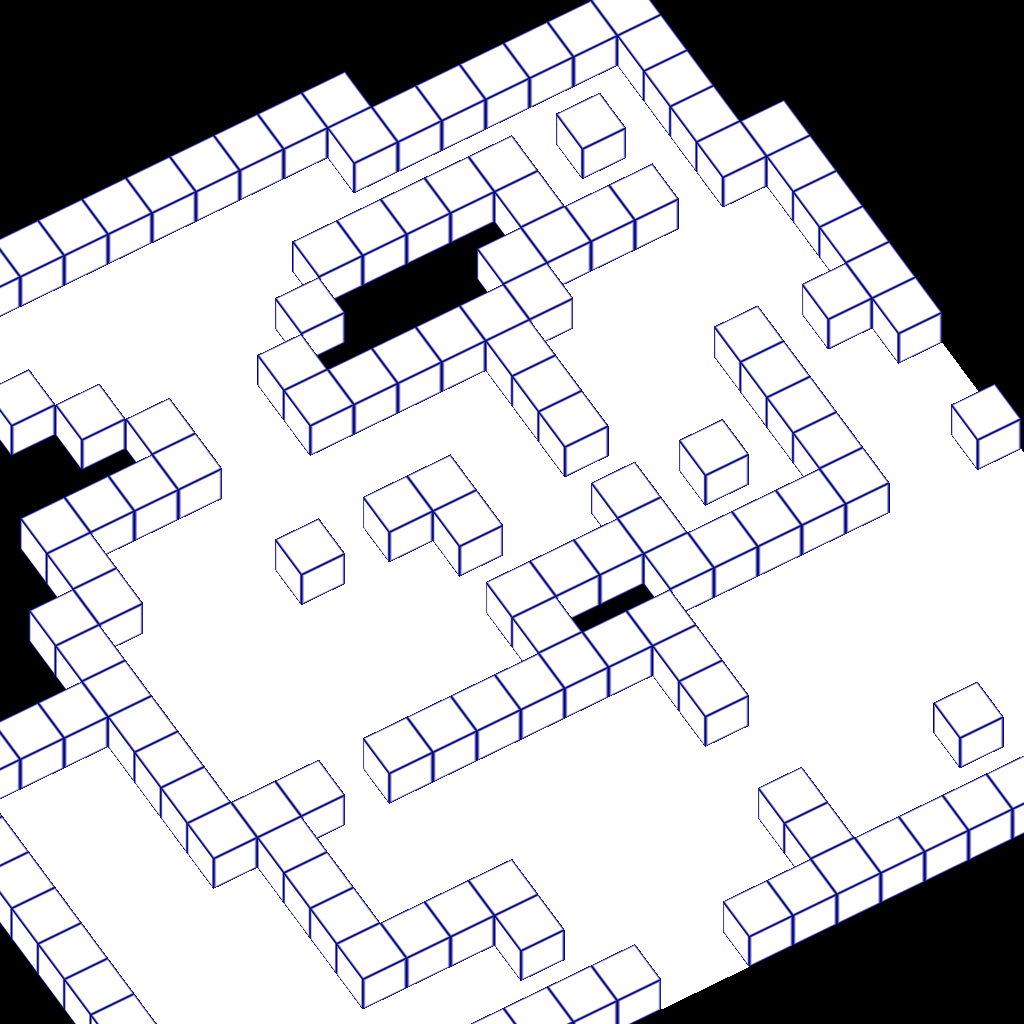
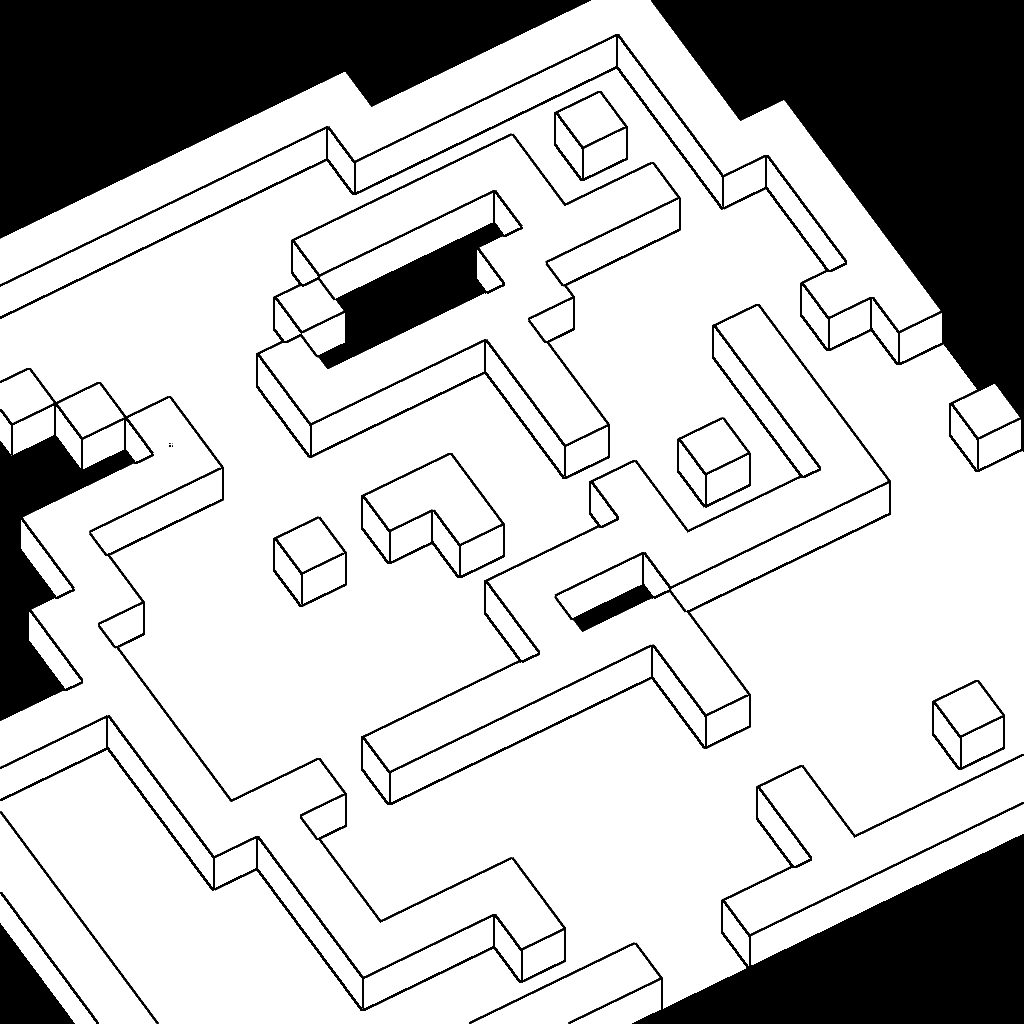
The second thing I wanted to do was to implement all of this in shaders. My first attempt was to draw a "surface id" to a texture, and then draw black outlines whenever the surface changes.
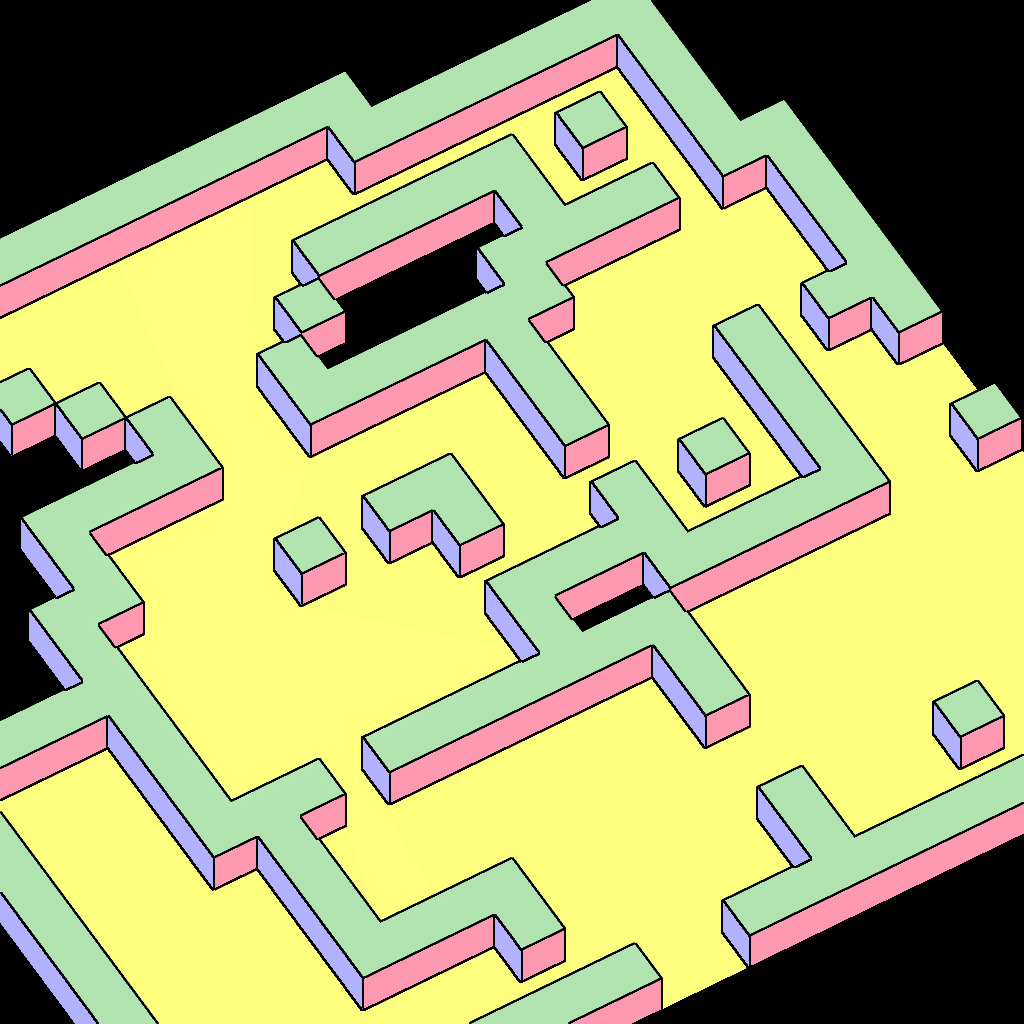
There were lots more details to implement, including outlines around billboard sprites, field of view, and lighting of wall blocks beyond the outline.
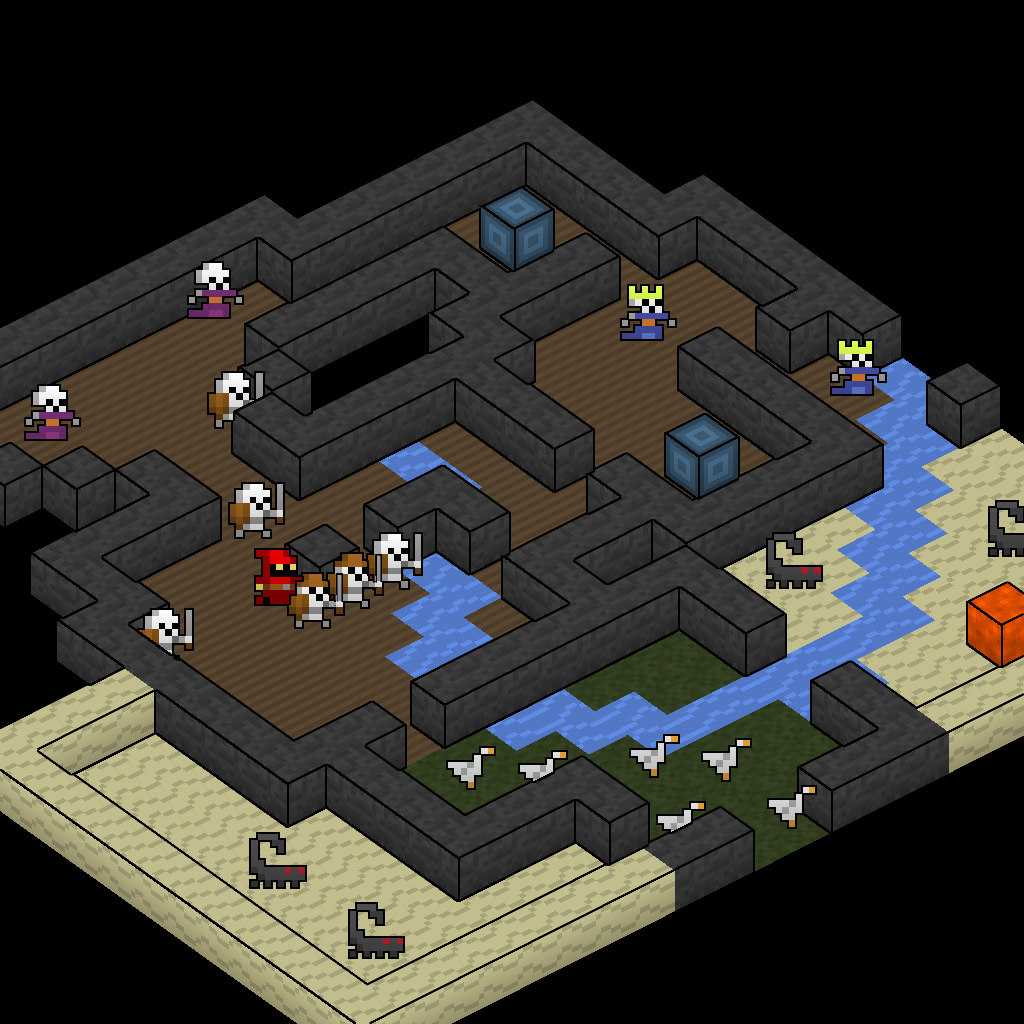
I was pretty happy with that, even though it had some glitches, and I decided that project was finished.
A few weeks later I re-opened this project to explore a different approach. Instead of drawing the lines in a post-process step, I wanted to draw the lines as the sprites were being rendered. I posted some images on Twitter and got a suggestion from @Rezoner, who had made a version where some lines were white and some were black, depending on camera direction. I took that idea and ran with it, making white lines where the player could see the walls.
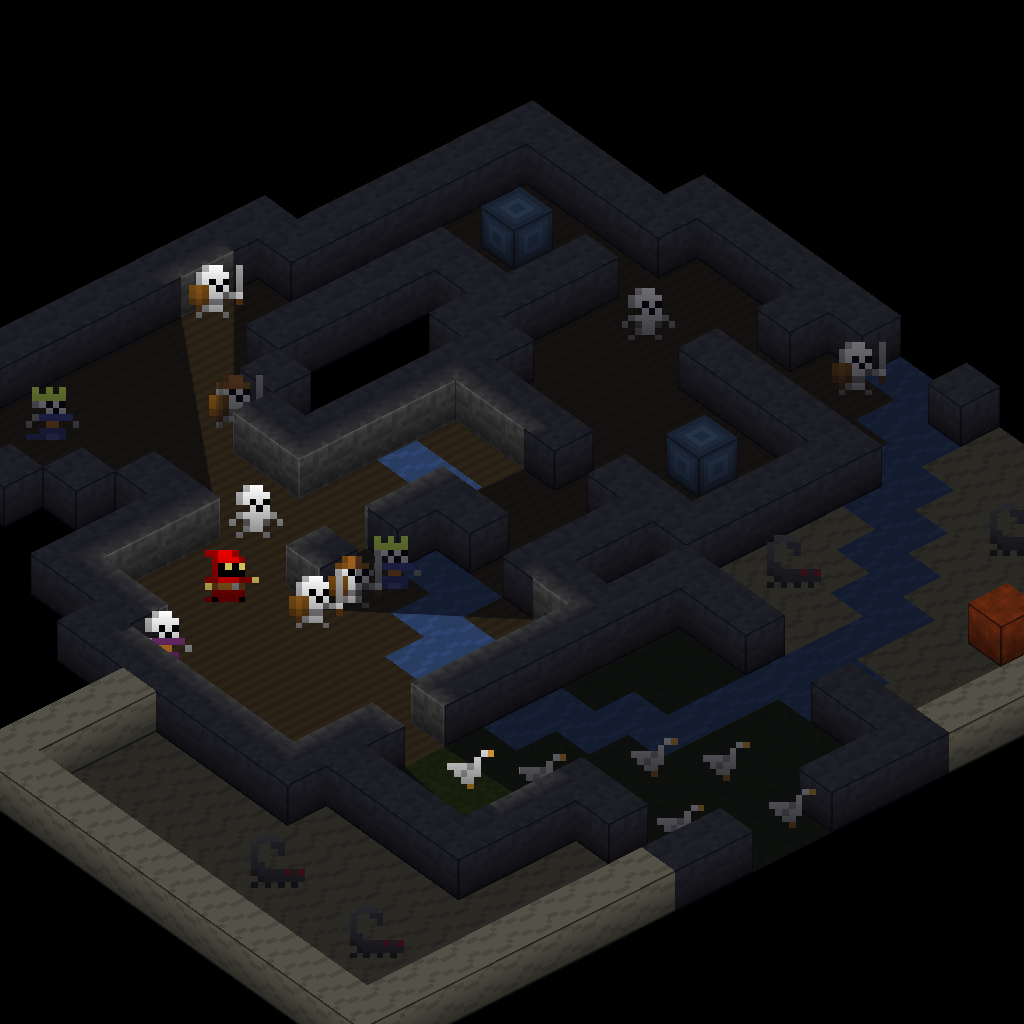
I was pretty happy with this version too. I then merged the code together into one unified demo, with a toggle. Now I think I'm finished. But who knows? Maybe I'll re-open it later.
Things for me to keep in mind:
- The one-week self-imposed deadline is just a rough guide. I don't have to follow it strictly.
- Sharing unfinished work can lead to more ideas for improvement. I should share more things early.
- Sometimes all I need is a proof of concept. I don't need to make everything work perfectly. If I actually use this in a real project, I can work out those details then.
Langganan:
Postingan (Atom)